Calibrate model predictions in R with Inductive or Cross Venn-Abers methods. vennabers supports binary and multiclass classification (one-vs-one or one-vs-rest), regression, and optional tidymodels workflows. Start with Venn-Abers methods and their guarantees for what the predictors compute and what they guarantee.
Get started
Fit a calibrator using probabilities from a model trained on separate data:
library(vennabers)

calibrator <- venn_abers(
  truth = c(FALSE, TRUE, FALSE, TRUE),
  probability = c(0.1, 0.4, 0.35, 0.8)
)
predict(calibrator, c(0.2, 0.5, 0.9))
The result contains lower and upper Venn-Abers bounds and a regularized probability. The bounds are not confidence intervals. Keep final assessment data separate from training, selection and calibration.
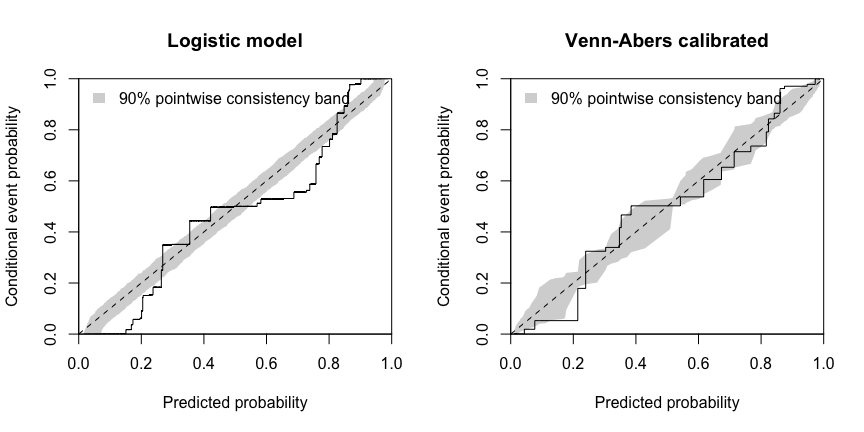
A logistic regression that is linear in x cannot follow event probabilities of plogis(x^3). Calibrated on separate data, its probabilities follow the diagonal of the CORP reliability diagram on independent assessment data; the comparison guide adds Platt scaling and isotonic calibration.
Choose a guide
- Venn-Abers methods and their guarantees: start here for what Inductive and Cross Venn-Abers predictors compute, what is guaranteed and what is not, for classification and regression.
- Venn-Abers, Platt and isotonic calibration compared: a small illustration on simulated data, with separate training, calibration and assessment sets and the limits of what one data set shows.
- Calibrating supplied predictions: binary and multiclass classification, regression, Inductive/Cross methods, scoring and plots.
- Diagnose and assess calibration: fit diagnoses of the stored calibration map, CORP reliability diagrams with uncertainty bands, the Brier decomposition and regression assessment plots.
- Training and freezing calibrated workflows: preprocessing, model training, postprocessing and already fitted workflows.
- Tuning and assessing the complete procedure: Grid/Bayes selection, outer resampling and independent assessment.
The package overview connects the main interfaces. Use the function reference for argument details and release notes for changes.
Installation
The package requires R 4.5 or later. Install the released version from CRAN:
install.packages("vennabers")Or install the development version from the source repository:
# install.packages("pak")
pak::pak("RMKruse/vennabers")
Manual calibration needs no additional R packages. Workflow integration and building the guides use the optional packages listed in DESCRIPTION; guide building also requires Pandoc.
Further examples and support
Browse the annotated example scripts by topic. Each article has a contents list and commands for running the installed originals:
- Manual calibration: binary options, multiclass OvO/OvR, one-hot class decisions and regression, including Cross fold matching, fit diagnoses and assessment graphics.
- Training and frozen workflows: own fit and predict functions, fixed engine options, schemas, independent Inductive sizes, full-model transfer, pairwise training and adoption of already fitted models.
- Learned postprocessing: Sigmoid, Tailor and isotonic holdouts, ensembles and full compositions.
- Grid and Bayes selection: binary, shared multiclass, pairwise and regression searches, including postprocessing.
The example index in the R help also lists the installed scripts and vignette commands. Report problems in the issue tracker.